Showing posts with label weaving. Show all posts

Thursday, June 7, 2012

Woolgatherers in Fond du Lac


Our last SDA meeting on May 19 was held at Woolgatherers in Fond du Lac. Shop owners Sara and Hans von Tresckow recently expanded their business to this larger store where they have an extensive variety of spinning, weaving, and knitting fibers and supplies.

Sara learned to weave while living in Germany for 20 years. She is largely self-taught through books, some lessons, observation of professional weavers, extensive museum visits/connections. She has always been interested in textile history and archaeology. Sara weaves on countermarche looms, a 16-shaft computer assisted dobby, a 50-pattern shaft drawloom with 8 ground shafts, and Jacquard looms.

Her beautiful woven work centers on household linens and rugs, decorative items from the drawloom, and clothing fabrics/scarves. Sara studied drawloom weaving with Joanne Hall and took three courses in Jacquard design at Eastern Michigan University, Oaxacan rug weaving with Wence Martinez, and Jacquard weaving at Oriole Mill with Bethanne Knudsen.

In addition to selling finished pieces and supplies, Sara also provides private instruction for beginners as well as advanced weavers. Hans, the engineer and woodworker in the family, evaluates, repairs,  restores, and maintains looms and spinning wheels.


Hans and Sara are available for seminars, lectures, demos or event booths. Their website contains details about looms, wheels, lessons as well as their show schedule. If you have questions or needs regarding spinning or weaving, these are the folks to call!

4
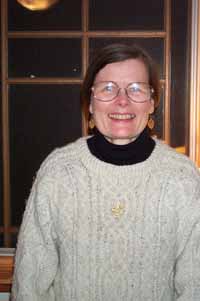
Sara von Tresckow
Hans von Tresckow


 Look for the Woolgatherers at the Wisconsin Sheep and Wool Festival in Jefferson, WI September  7-9, 2012 and at the Townline Art Fair at The Fine Line Gallery in Ephraim, WI.

Many thanks to Sara and Hans for hosting and supporting the Wisconsin SDA!! Sara, who was able to join the meeting while Hans watched the store, brought insights and humor along with her 30 years of fiber arts experience. We enjoyed getting to know you and your shop.

For more information visit Woolgatherers or email Sara.

Fine Line Designs Gallery
Wisconsin Sheep and Wool Festival

Coming soon--- new rep Lisa Sattell's blog about the meeting.

Sunday, October 9, 2011

OPEN STUDIO -- LAURA FISHER-BONVALLET


National award winning designer, weaver, dyer, and SDA member Laura Fisher-Bonvallet, is hosting an OPEN STUDIO WEEKEND Oct. 7-9, 2011.  The 2011 Collection that won the prestigious NICHE Award (Niche Magazine, a national arts publication) will be showcased, along with work from previous collections.  In addition to handwoven wearables, Fisher-Bonvallet has also designed two different series of hand-dyed silk scarves.  All items will be for sale, many offered at deep discounts. 
  
To preview, go to www.LauraFisherBonvallet.com.  Hours are Friday, noon-5p, Saturday, 10a-6p, and Sunday noon-5p. 1150 Hill Drive, Oneida, WI 54155 – Hwy 29 west to Cty FF, south on FF .6 miles, west on Hill drive .4 miles. For more information dial 920.499.9899 or info@LauraFisherBonvallet.com.  Come and enjoy some refreshments while shopping right in the artist’s studio!

Laura's website

Tuesday, June 28, 2011

Online Auction: Looms/weaving supplies

The UW Oshkosh Art Department is selling equipment and supplies from its Weaving Studio!

They have looms, various collections of weaving magazines & journals, weaving supplies, and patterns.


Wednesday, June 23, 2010

"Woven Lives: Contemporary Textiles from Ancient Oaxacan Traditions" An Interview with Artist/Filmmaker Carolyn Kallenborn


SDA member Carolyn Kallenborn is an award-winning artist whose hand-painted garments and sculptures have been shown nationally and internationally. In July 2010, Carolyn will become a film producer as she heads to Mexico to film "Woven Lives: Contemporary Textiles from Ancient Oaxacan Traditions”. This is Part 1 of a 2-part interview with Carolyn:


How did the film project get started?

I’ve been going down to Mexico every year since 2003. Sometimes I bring [UW- Madison] students with me. It was so amazing to see the work of the artisans and weavers so it was always in my mind to bring this experience and beauty here [US/Wisconsin]. I brought this up in a conversation with filmmaker, Andrew Galli, owner of Galli Film Studio in San Francisco about a year ago. I recently received a grant through the University of Wisconsin to pay for production costs.


The movie focuses on 5 different Zapotec families who weave cloth in the ancient traditions of their ancestors. Could you elaborate?

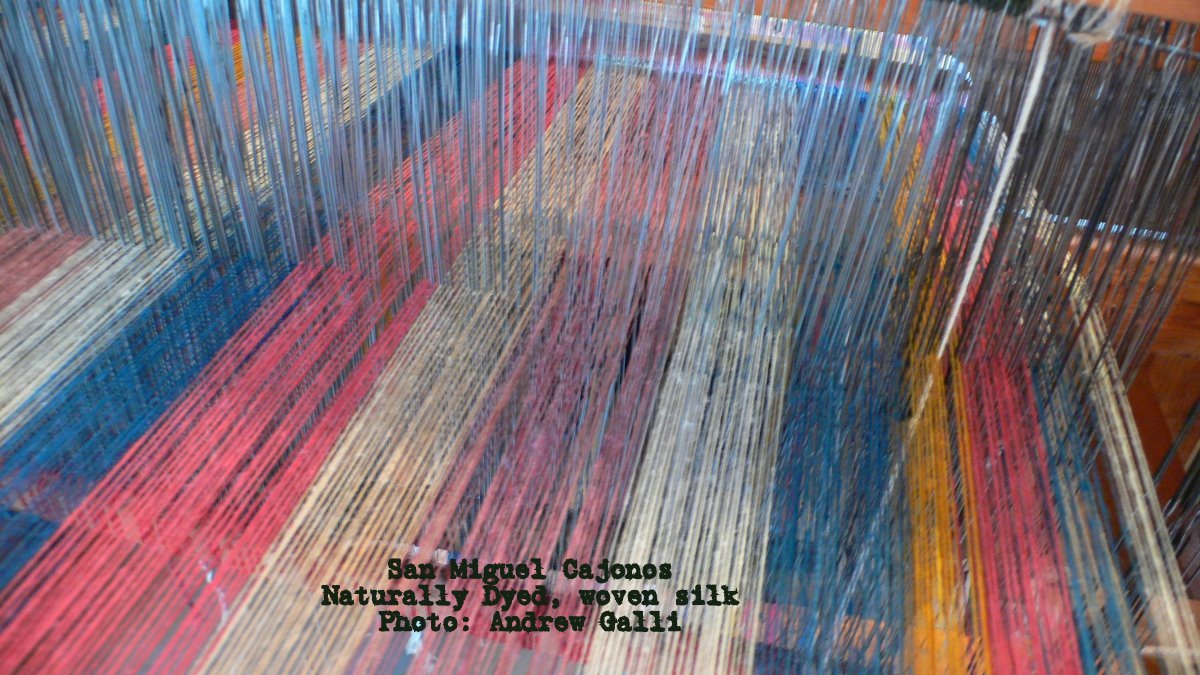
Yes, the film will focus on one or more families in 5 different Zapotec villages. In most of the villages around Oaxaca (pronounced Wah-Ha-Ka), there are craft villages in which individual families are making their individual works in their homes. Each village specializes in one type of craft such as green pottery, silk, weaving. Each individual craftsmen has different type of specialty e.g. rug weaving, backstrap weaving, silk weaving, fat weaving with a fly shuttle and lightweight cotton or hand-dyeing using insect extracts.


For centuries the Zapotecs have been cultivating cochineal, an insect which feeds on the native nopal cactus and yields the world’s most brilliant red dye. For over two hundred years cochineal was the second most expensive export from Mexico and was very tightly controlled by the Spanish; smugglers faced the death penalty. Pirates loved it because it was lightweight and easy to transport. Some Zapotecs still raise the insects that their ancestors domesticated from the wild and which were even used to pay tribute (taxes) to the Aztecs. These traditions have been going since 1000 BC. The Perfect Red by Amy Butler Greenfield is an in-depth look at the fascinating history, uses and cultural aspects of the cochineal.

Many of the dyes used are made from plants and animal sources- mosses make greens, a different moss produces a brilliant yellow, indigo plants make blue, tree bark or nuts for brown, pomegranates for black. By using various fermentation processes, tweaking the Ph and adding other ingredients such as urine, or iron an amazing range of colors can be produced.  

The focus of the documentary is on the art and tradition rather than the technical how-to aspects of each craft, though there will be plenty of technical information that can be gleaned just by watching what they do. Each craftsman’s expertise, their eye for color, and how these abilities are used to create art which supports their families will be explored.


It seems “family” and “tradition” are important factors in their work?

Family is central to the making of the craft; weaving looms are in the middle of home, in the family patio or courtyard. Some have separate shops to sell their art but most of the weaving is done in the home. In some types of weaving the men are the primary weavers and in others the women do the weaving. The women often take care of household duties and weave in between those duties. The kids are often helping wind bobbins or just playing around the looms, it’s very interactive.


There’s a strong tie to community and they are required to give time back to community. They work very hard and there’s a lot of trade and barter. In many of the Zapotec towns there is a complex mandatory volunteer system that takes care of much of the village labor: the mechanic, the driver, the cashier for the community bus, building infrastructures like water systems or roads. All are done in volunteer service to the community.


How are the crafts sold?

It varies. Some families have stores in town. Some sell at the market stalls. Several of the villages have a cooperative markets where everyone’s rugs are being sold. Most homes have a space set up to display items for sale for walk-in customers.

Most all of them have done commission work— anything from special colors or sizes to logos, team colors, special orders, or specific motifs are not unusual. One weaver produced hundreds of rugs for a purse and shoe designer.


What are your responsibilities as producer?

My main role is controlling content, storytelling, script, and researching the material. My background is with these people, I know them. I’ve stayed with them in their homes and am now weaving it into a compelling story. The filmmaker will visually capture the story. The editor will pull the sounds and visuals together to make a feast for the eyes and ears.


Where will the movie be released/shown?

The pre-release lecture will be in Costa Rica in September. I’m scheduled to do a lecture in London in November and it will be shown at the 2011 SDA Conference in Minneapolis.


Part 2 of this interview will focus on Carolyn's personal connection with
 Oaxacan families which inspired her to create her exhibition called “Aucencia”.